
Exploring Inlined Requires to Improve Cold Start
/ 1 min read
A Hermes CPU profile of our Android app’s cold start had a single block of metroRequire calls running for 2.8 seconds.
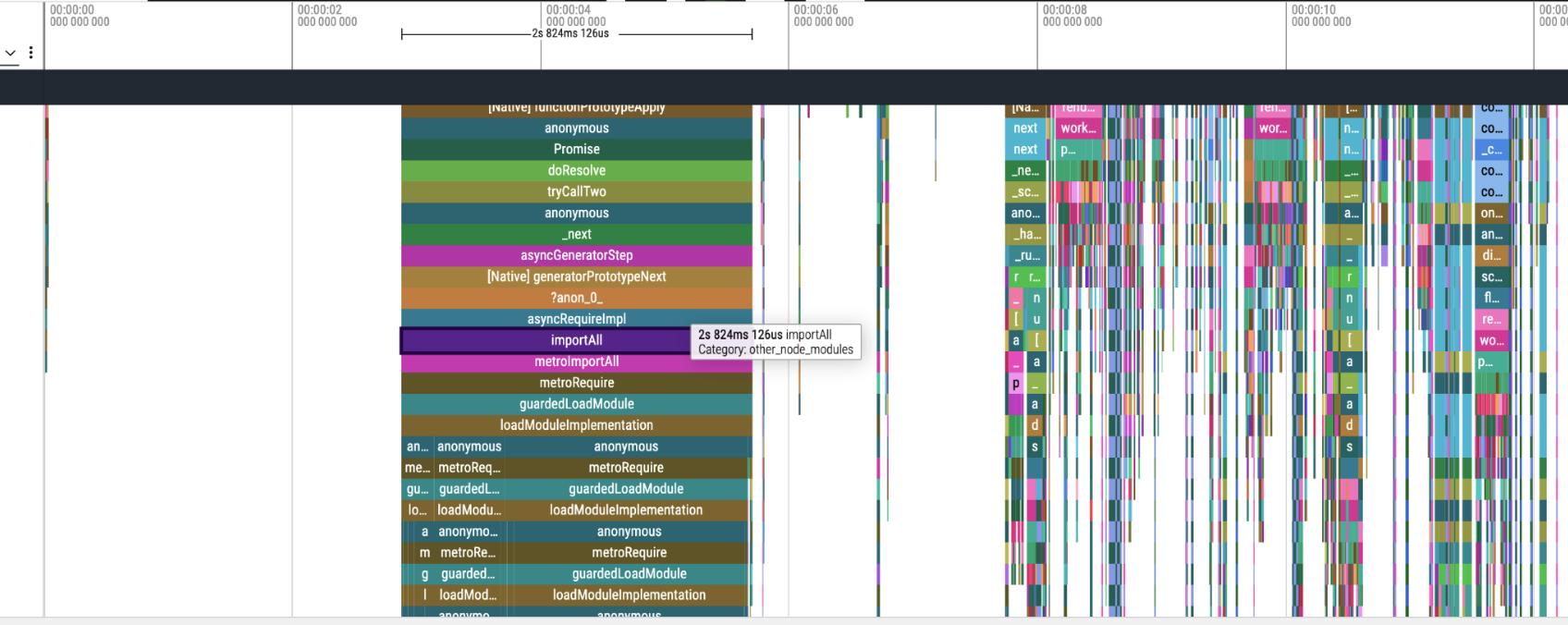
Every frame in that flamegraph is the same call stack: importAll → metroRequireImpl → guardedLoadModule → loadModuleImplementation. The JS runtime evaluating every require() it encounters — eagerly, synchronously, at startup.
This kicked off three threads of work:
- How do inlined requires actually work? The flag is supposed to defer module evaluation. We turned it on and the profile barely moved.
- Why didn’t it help? There’s a structural class of modules the transform cannot defer, and we were full of them.
- Does Expo Router solve this automatically? File-based routing promises lazy screens by default. We verified the mechanism.
The series:
- Exploring Inlined Requires: How They Really Work — what the transform does to the bundle, what Expo does differently, and what rnx-kit’s esbuild path actually changes.
- Exploring Inlined Requires: When Flipping the Flag Does Nothing — the war story, eager aggregators, and the structural fix.
- Exploring Inlined Requires: Does Expo Router Give You Screen-Level Lazy Loading? — yes, and here’s the exact mechanism.