
Relay is a great tool. But you should not put all your data in it. Some data gets no benefit from the normalized store, and you still pay the full cost.
1. What Relay Solves
Relay gives you a normalized client-side cache. When a GraphQL response comes back, Relay stores each entity by a global id. If the same entity appears in two different queries, Relay keeps one copy. When that entity changes, every screen that reads it updates.
You do not think about how to store the data. You do not write reducers. You do not sync one screen with another. You read a fragment and Relay does the rest. For genuine entities — a user, an asset, a portfolio — this is exactly what you want.
2. The Cost of Relay
The normalized store is not free. You pay twice.
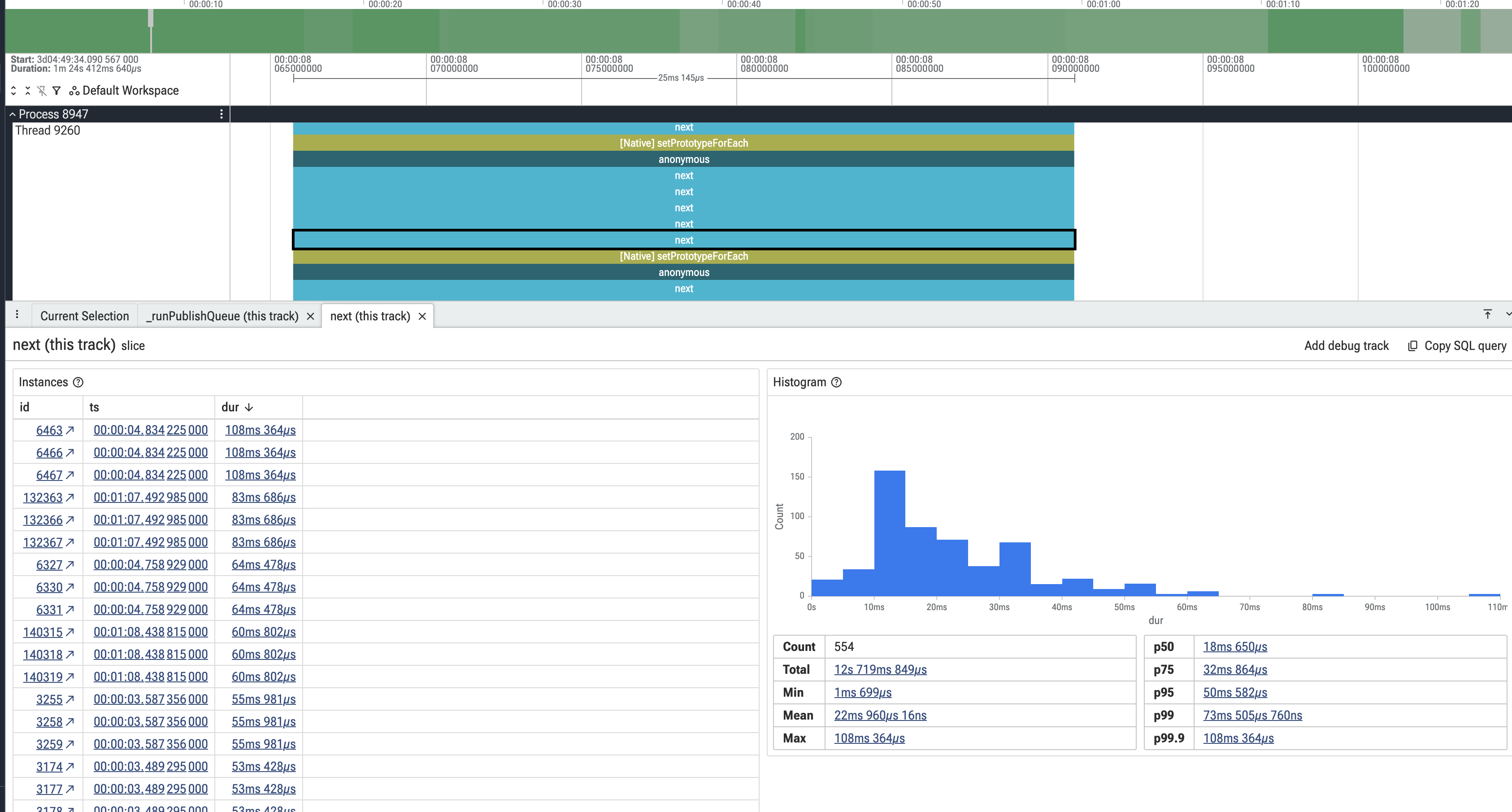
Can you imagine paying 12 seconds in a 50 seconds window to just data normalization plus subscription?
- Normalization CPU. Every response is normalized into the record map. Every store read runs referential-equality maintenance that scales with the store size. The bigger the store, the more work per read.
- Persistence CPU. To persist the offline cache, Relay must
JSON.stringifythe whole record map and deep-copy every record.
I have seen a Relay store grow to ~18 MB in memory from unchecked usage — teams
just kept adding fragments and never asked what belonged in the store. The
default, naive persistence solution then pays a hefty price. It must
stringify this whole blob and deep-copy every record to write it to disk, on
every persist. Both costs scale with the store size. A bigger store taxes every
read and every write.
3. What Does Not Benefit From the Normalized Store
Here is the key point: much of the store gets no benefit from normalization, but pays the full price.
In that ~18 MB store, the large majority, by bytes, was data that is never cross-referenced and is read as a whole:
- Client config — keyed by query argument, read as one map.
- Experiments — index-based ids that churn on every refetch, read-only.
- Volatile market data — price series and FX quotes, high-churn time-series read as arrays.
- Server-driven UI — render trees keyed by surface query, read as a whole.
- Inlined assets — Lottie JSON stored as strings inside a text field.
For this data, normalization invents synthetic id keys that are often larger than the values they point at. In these snapshots, 16–29% of the whole store was nothing but synthetic id strings.
None of this needs cross-query consistency. None of it is updated in place. There is no shared entity to keep in sync. It is a document cache pretending to be a normalized graph.
The Rule
Keep genuine entities in Relay — viewer, assets, portfolio, anything you cross-reference and update in place. That is where normalization pays off.
Move read-mostly, no-overlap data out. A plain store (for example Zustand) with
its own fetch, refresh, and persist policy is strictly cheaper. You store the
JSON as-is and read it with a getter. No normalize pass. No whole-store
stringify.
Not every query needs a normalized cache. Use Relay where it earns its cost, and not where it does not.